Researcher : Dr. Chae Bin Kim, 김채빈 (Ph.D): 2016.09~2017.08 @ KIST
Graduate Student: Ki-Beom Jeong, 정기범 (Master Course): 2016.01~2017.08 @ KIST
Polymer & Organic Energy Materials
Research
Bridging the Synthetic and the Biological
Encoding biological intelligence into synthetic matter to engineer a resilient, bio-hybrid planet. Bridging synthetic precision and biological complexity to close the loop on the Water-Energy-Food nexus.
We transcend the traditional divide between the living and the non-living.
By translating the structural logic of nature into synthetic systems, we design matter that mimics life’s most defining traits: adaptability, selectivity, and communication.
Our research utilizes molecular programming to create circular polymers that heal and degrade on command, and porous architectures that mine critical resources with high precision. From engineering bio-interfaces that augment bacterial metabolism to building sensory networks that digitize ecological signals, we apply this "biological intelligence" across scales.
Ultimately, we are architecting a symbiotic infrastructure to secure water, energy, and food for a changing planet.
Programmable & Circular Materials:
Programming matter to adapt, heal, and degrade on command

"Turning passive plastics into active, healing, and circular systems."
We transcend the concept of simple recycling. We design programmable polymers and bio-inspired adhesives that dynamically reconfigure their own structure. By mimicking nature's self-assembly, we create materials that serve critical medical and environmental needs before degrading on command—closing the loop of the circular economy with molecular precision.
Precision Resource Mining: Harvesting critical resources with molecular precision

"Mining critical resources from the most complex mixtures on Earth."
We view separation not as filtration, but as precise molecular logistics. We engineer highly selective porous architectures capable of hunting down specific ions (like Lithium) or purifying water in extreme environments. Our goal is to turn waste streams into valuable resource mines using energy-efficient, nature-mimetic transport channels.
Symbiotic Bio-Interfaces: Augmenting living systems for metabolic control
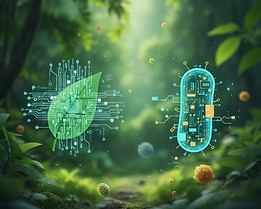
"Hacking the biological firewall for metabolic control."
This is where biology meets nanotechnology. We develop "Second Skins" for bacteria and plants—functional coatings that protect living organisms from harsh environments while enabling us to control their metabolism. Through molecular communication, we create hybrid systems where artificial assemblies direct biological factories to fix nitrogen, sequester carbon, or accelerate growth.
1) Angew. Chem. Int. Ed. 2025, e202416114
Environmental Intelligence: Digitizing the chemical signals of our ecosystem
